
Winners, Losers & Market Signals
June 2026 · Oil, Gas & Consumable Fuels · India · United States · United Kingdom
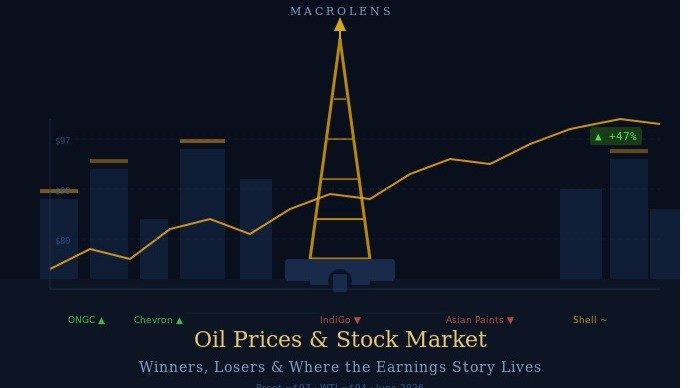
Oil is one of the sharpest macro transmission variables in equity markets, moving inflation expectations, freight costs, corporate margins, and monetary policy in a single price. With WTI at $95.96/bbl, sector divergence between crude beneficiaries and fuel-cost-sensitive businesses is widening fast.
Current Oil Market Setup
Before examining equity sensitivities, here is the macro backdrop driving this analysis.
OPEC+ restraint and recovering Chinese demand have kept crude elevated. US shale offers only modest offset. The result: a widening earnings gap between oil beneficiaries and fuel-sensitive businesses.
India: Energy vs Fuel-Sensitive Sectors
Positively Correlated, Key Names
ONGC is the clearest oil price proxy in Indian equities. As the country’s largest upstream producer, earnings move directly with crude realizations. Each $10/bbl shift in Brent has a material impact on operating profit.
ONGC (NSE), WTI Spot Price signal vs stock price on Investilo AI
Reliance Industries has a more complex but still positive oil relationship. Refining margins (GRMs) widen in elevated crude environments. Petrochemical spreads benefit from the broader energy complex.
Other positively correlated Indian names: Oil India (pure-play upstream), Chennai Petroleum (refinery margins), GSPL (gas transmission volumes).
Negatively Correlated, Key Names
IndiGo faces the most direct oil headwind. Aviation turbine fuel (ATF) is priced off global jet benchmarks and is the airline’s leading cost item. Crude sustained above $90/bbl compresses airline EBITDA margins by 3–6 percentage points.
IndiGo (NSE: INDIGO), WTI crude signal overlay on Investilo AI
Asian Paints and Pidilite Industries carry indirect crude exposure via petrochemical-derived raw materials. Cost pass-through typically lags a crude rally by one to two quarters, compressing margins in the interim.
United States: Majors vs Transportation
Positively Correlated, Key Names
Exxon Mobil is the flagship oil price beneficiary in US equities. Its integrated upstream, chemicals, and refining model means higher crude lifts production revenue and downstream spreads simultaneously. Crude earnings sensitivity ranks among the highest in the S&P 500.
Exxon Mobil (NYSE: XOM), WTI Spot Price correlation on Investilo AI
ConocoPhillips offers the highest pure-play E&P leverage among US majors. With limited downstream diversification, earnings respond directly to crude swings. Chevron sits between the two: strong upstream exposure with a partial integrated buffer.
Other positively correlated US names: Occidental Petroleum (Permian production base) and SLB, which benefits as higher crude prices incentivize upstream E&P capex.
Negatively Correlated, Key Names
Delta Air Lines carries one of the highest fuel cost ratios among US carriers, jet fuel is approximately 22% of operating costs. Sustained crude above $90/bbl compresses margins even when hedging programs are in place.
Delta Air Lines (NYSE / LSE: 0QZ4), WTI crude signal on Investilo AI
FedEx and UPS both absorb elevated fuel costs across air and ground networks. Surcharges provide a partial offset, but the mechanism lags spot prices by 4–6 weeks, creating a near-term earnings drag during sharp crude rallies.
United Kingdom: Oil Majors vs Airline Groups
Positively Correlated, Key Names
Shell is Europe’s largest oil and gas company and the primary crude price proxy on the LSE. Globally diversified upstream, LNG trading, and refining operations make it a core holding for energy-sector exposure. BP follows a similar integrated profile with material upstream earnings leverage.
Shell plc (LSE: SHEL), WTI Spot Price signal vs Shell stock on Investilo AI
Negatively Correlated, Key Names
IAG, parent of British Airways, Iberia, Vueling, and Aer Lingus, carries concentrated fuel exposure across four brands. Fuel represents 20–25% of group operating costs. The multi-brand structure limits the ability to rapidly cut capacity when crude spikes.
IAG (LSE: IAG), WTI crude oil cost impact on Investilo AI
easyJet amplifies the pattern. As a low-cost carrier, its lean operating model offers minimal buffer against crude upcycles. Sustained crude above $90/bbl can materially compress low-cost carrier margins.
Approximate Oil Price Correlation, Comparative View
The table below summarises approximate oil price correlations across all companies covered. Figures are directional estimates based on historical price relationships, treat as analytical context, not precise statistical measurements.
WTI Crude vs ONGC, 2026 YTD
Trade Setup: Beneficiary vs Sensitive Pairs
The pairs below frame oil sensitivity as relative value positioning. These are thematic analytical frameworks, not formal investment recommendations.
Final Thoughts
Oil sensitivity is one of the sharpest macro lenses in equity markets. With OPEC+ discipline holding and global demand recovering, the divergence between upstream beneficiaries and fuel-cost-sensitive businesses looks set to persist.
WTI sustained above $90/bbl widens the performance gap between upstream producers and fuel-sensitive sectors. Oil sensitivity is becoming a primary factor in sector rotation and equity allocation.
Data sources: Investilo AI · EIA · OECD · BLS · Reserve Bank of India Disclaimer: Correlation estimates are directional and based on historical price relationships. Not investment advice.
This article is for informational purposes only and does not constitute investment advice.