
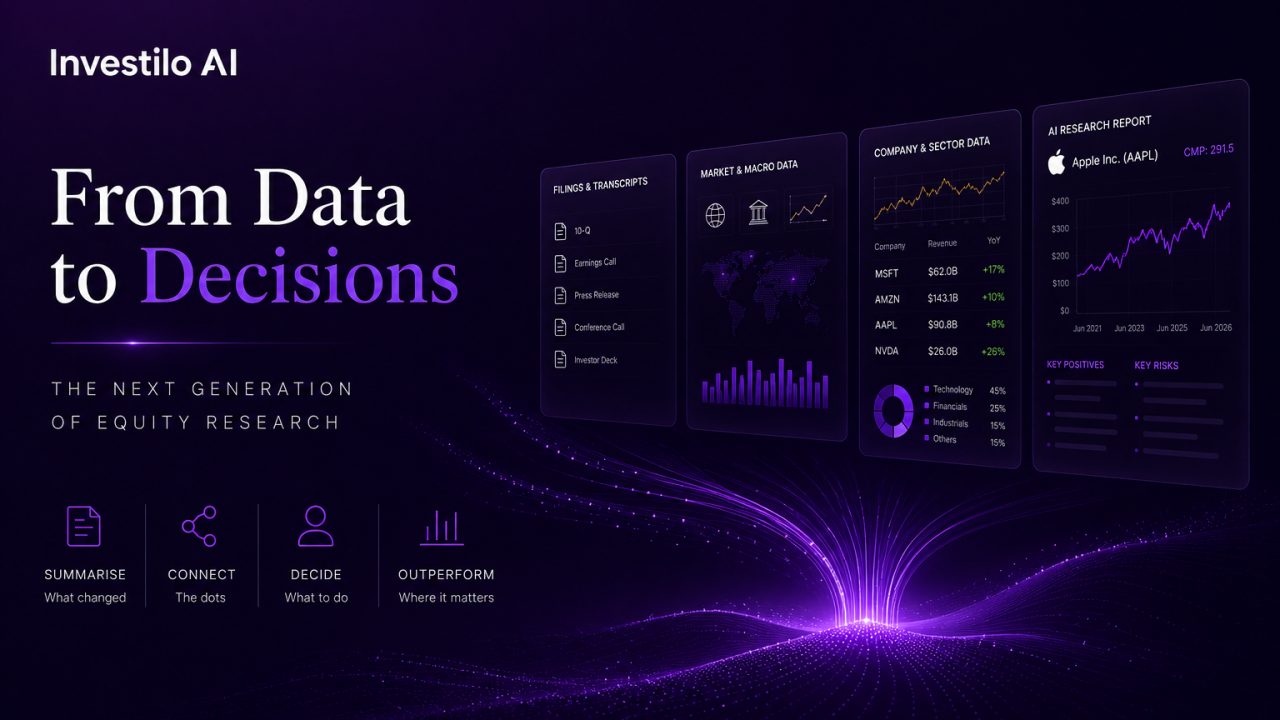
Every quarter produces more financial information than any individual can read: filings, transcripts, releases, prices, and macro data arrive faster than anyone can absorb them. Yet abundance has not made analysis easier. When information is everywhere and effectively free, the scarce resource is no longer access; it is attention. The analyst’s edge has shifted accordingly. It no longer lies in finding data, but in interpreting it: deciding what deserves attention, what it means, and what to do about it.
This note argues that research platforms must follow that shift: evolving from databases that store information into workspaces that help interpret it. The most useful systems will not simply hold more data; they will connect it, surface what changed, and leave the judgment where it belongs. Tools that merely add another feed do not help, because the constraint they need to relieve is attention, not access. What follows sketches what such a workspace looks like, and the role artificial intelligence should and should not play within it.
Why Traditional Research Is Broken
Information is no longer the bottleneck; the workflow around it is. A single valuation still draws on systems that do not talk to each other: the model in a spreadsheet, the filing on a regulator’s portal, the transcript on another service, peer multiples on a screener. The analyst becomes a courier, copying a figure out of a PDF into a model and reconciling sources that disagree. The cost is not only time but cognitive load and error, concentrated in the gathering that adds the least analytical value.
Worse, context is lost between tools: the reason a number mattered rarely travels with the number itself. When the same metric surfaces in three places with three values, scarce judgment is spent adjudicating bookkeeping rather than assessing the business. A modern environment should compress that gathering so the hours saved move to interpretation, where the edge actually lives, and should keep the connective tissue, the why behind each figure, intact across the whole workflow.
AI as a Research Copilot
An effective platform treats AI as a copilot, not an oracle, and its value concentrates in three things.
First, it summarises. Reading a 300-page filing for the few paragraphs that changed, or condensing a 90-minute call into revised guidance, is necessary, time-consuming, and low-value once done. A capable system reads every filing in a watchlist overnight and surfaces only what moved, so what once took a morning of skimming becomes a short digest the analyst can act on or dig into.
AI summarises: an automated read of Apple’s latest 10-Q, with a confidence tag and a prompt to verify the original.
Second, it connects. The harder, more valuable work relates one signal to another: flagging where this quarter’s guidance contradicts what management said two quarters ago, noting a shift in tone from confident to hedged, or tracing how a 50-basis-point move in rates flows unevenly through banks, NBFCs, and REITs. Connection is where interpretation begins, because a fact in isolation rarely changes a view, while the same fact set against its own history often does. Used conversationally, the same engine turns a plain-language question into a structured first-pass analysis the analyst can interrogate.
AI connects: a conversational request returns a structured first-pass analysis, here a DCF executive summary with the key financials pulled out.
Third, the human decides. A summary is not a thesis, and a generated model is not a judgment about whether its assumptions are sane; the decision, and the accountability for it, stay with the analyst. Explainability therefore matters as much as the answer: a number you cannot question is not research. Treated this way, AI widens an analyst’s reach without diluting responsibility for the call.
The Eight Intelligence Layers
If AI handles the reading and the connecting, the workspace still has to present the result in a form a decision-maker can use, organised around the questions an investor actually asks rather than the systems that happen to hold the data. A complete view of a stock answers eight of them at once, moving from the broadest context to the most specific portfolio decision:
- Market Intelligence: What is happening?
- Company Intelligence: How is the business performing?
- Sector Intelligence: How does it compare with peers?
- Valuation Intelligence: Is it undervalued or overvalued?
- Macro Intelligence: How do rates and the economy affect it?
- Technical Intelligence: When should investors act?
- Sentiment Intelligence: What is already priced in?
- Portfolio Intelligence: Does it improve the portfolio?
Today these layers are scattered across excellent specialist tools: charting in one, fundamentals in another, screening in a third. The shift now underway is to integrate them into one explainable flow, so the answers can inform each other instead of sitting in separate windows.
Company and sector intelligence: MSFT compared with AMZN across price and revenue growth. Valuation intelligence: an AI-generated DCF intrinsic value against current market capitalization. Macro and sentiment intelligence: a leading indicator tracked against price, with news-sentiment tone. Technical intelligence: trend, moving averages and momentum, with a backtester for timing and risk.
Individually, none of these views is new; analysts already ask all eight questions. What changes is having them in one place, where a weakening macro signal, a stretched valuation, and a deteriorating technical picture can be read together rather than reassembled from memory across a dozen browser tabs. It is also where mistakes get caught, since a thesis that looks clean on one layer often frays when laid beside another. Integration is not a convenience; it is what lets the answers inform one another.
Analyst Takeaway
- Data is no longer scarce; attention is.
- The edge has shifted from collecting information to interpreting it.
- AI removes repetitive work rather than replacing judgment.
- The future belongs to integrated research platforms.
Industry and market context
- AlphaSense, “Top Stock and Investment Research Tools for 2026.”
- Hebbia, “Best Investment Research Software Platforms (2026).”
- FactSet, “Investment Research / Research Management Solutions.”
- S&P Global Market Intelligence, “Investment Research.”
Methodological reference points
- A. Damodaran, Investment Valuation and the equity risk premium / discount-rate literature (NYU Stern), for the relationship between macro inputs, discount rates, and valuation multiples.
- Standard equity-research practice on industry structure, competitive advantage, and the relative weight of sector versus company factors in long-run returns.
This article is for informational purposes only and does not constitute investment advice.