
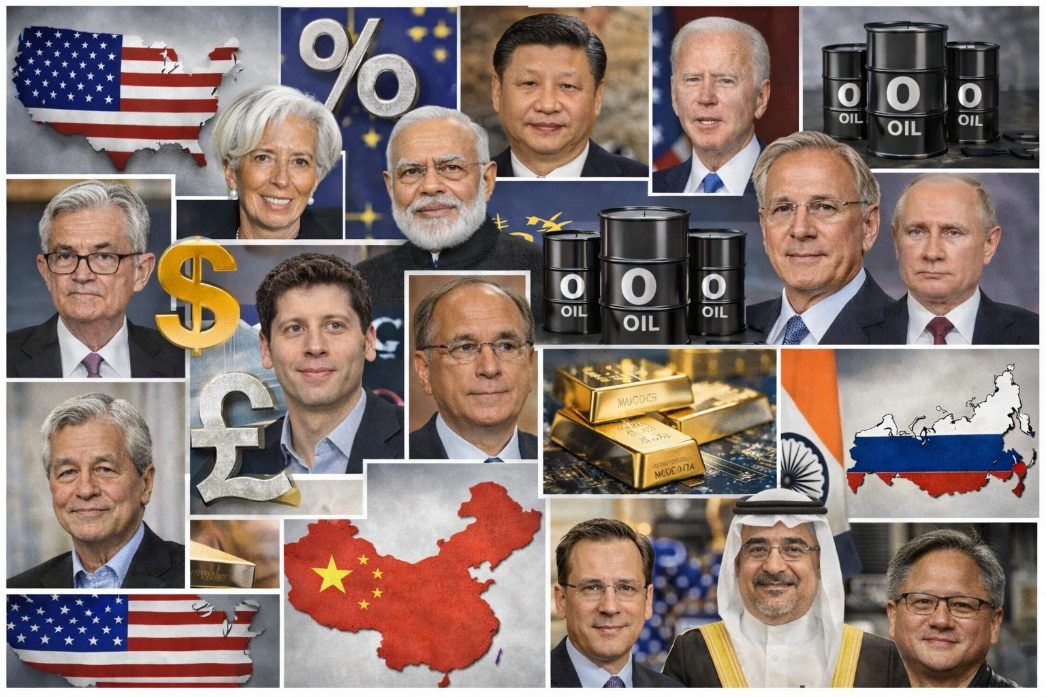
As we step into 2026, global markets are entering the year with a mix of optimism and caution. Leading analysts are focusing on a few dominant themes that could shape market performance across equities, rates, and assets this year.
Interest Rates
Many leading analysts anticipate that central banks may continue to keep policy rates elevated for an extended period, even as inflation gradually moderates.
Goldman Sachs
Goldman Sachs Research’s 2026 outlook highlights that although inflation is expected to moderate towards target levels across developed economies, central banks particularly the U.S. Federal Reserve may not rush into sharp rate cuts. Instead, policy easing could be measured, especially on inflation and labour market trends. Their baseline view anticipates a modest number of rate cuts during 2026, as inflation cools but remains above long run targets in parts of the developed world.
J.P. Morgan
J.P. Morgan’s global research also signals that monetary policy is likely to remain cautious in 2026, with central banks carefully balancing inflation expectations and economic resilience. Their Market Outlook 2026 report discusses how inflation is expected to stabilize closer to target levels in many regions, but still requires a measured approach to policy adjustments, favouring predictability over abrupt shifts.
Source: https://www.jpmorgan.com/insights/global-research/outlook/market-outlook
Equity Markets
Blackrock
As we move into 2026, many equity strategists are shifting their focus from valuation multiples (like Price to Earnings ratios) towards the quality and resilience of corporate earnings as the primary driver of stock performance. The idea is that markets may expand because companies deliver sustainable earnings and cash flow growth.
1. Quality Stocks Can Outperform in Uncertain Markets
Companies with stable profitability, consistent earnings growth, strong cash flows, and healthy balance sheets may perform better in this period of volatility or slower macro growth. These companies can be assumed to withstand economic ups and downs and generate real shareholder value over time, regardless of short-term valuation swings.
2. Earnings and Cash Flows
Since valuations are at historically high levels, future returns may be less influenced by expansion of multiples and more by earnings growth and cash generation. Investors and analysts increasingly argue that companies with predictable earnings and strong pricing power are positioned to outperform, since they can deliver real profit growth even if markets don’t re-rate valuations. The entire focus currently is towards the balance sheet.
Source: ?
Technology and Artificial Intelligence
Many analysts presently believe that artificial intelligence is moving beyond the hype phase into a stage where companies begin to turn AI investments into measurable revenue and profit growth. This is the year everyone is assuming when real business results start to show. We can conclude that right now investors and strategists are watching closely to see which firms can translate AI technology into scalable revenue streams and sustainable profits. Strategists at UBS emphasize that continued strong capital expenditure on AI infrastructure, combined with increasing evidence of actual monetisation of AI technologies, is expected to support further gains for companies in 2026. This indicates that the market will start rewarding companies that can show clear growth from AI deployment.
Source:https://www.ubs.com/global/en/wealthmanagement/insights/marketnews/article.2911345.html
Geopolitics and Commodities
According to Morgan Stanley, geopolitical risks are likely to remain a structural source of volatility in commodity markets through 2026, instead of being a temporary disruption. Energy and commodity analysts note that ongoing geopolitical tensions, policy uncertainty, and supply chain vulnerabilities continue to embed a risk premium into prices. They reflect particularly across oil, gas, and key industrial metals. Moreover, Morgan Stanley’s commodities outlook highlights that even when supply demand balances appear stable, policy shifts, regional conflicts, and strategic resource decisions can quickly alter market dynamics. This in turn keeps prices sensitive to sudden shocks. As a result, commodities are expected to remain reactive to geopolitical developments, thus reinforcing volatility as a defining feature rather than an exception in the year ahead.
Source: ?
Speculation to Institutionalisation****of Cryptocurrencies
Many analysts now view 2026 as a pivotal year in the evolution of cryptocurrencies, shifting from purely speculative narratives toward more institutional adoption, regulatory clarity, and integration with traditional finance systems. Research from digital asset firm Grayscale highlights that the crypto sector could see rising valuations across major tokens and deeper financial infrastructure roles, particularly if Bitcoin and other digital assets continue to attract institutional capital and ETF flows. One example is the ProFunds Bitcoin Strategy ProFund, which offers Bitcoin linked exposure through structures based on futures, without requiring direct ownership of the asset. This is viewed as a key step in broadening participation, improving accessibility, and aligning crypto exposure with familiar investment vehicles. While volatility remains inherent, these developments underscore a cautiously optimistic outlook for cryptocurrencies in 2026, driven by institutionalisation.
Source: , ?, ?, .
Bottomline
As 2026 unfolds, analyst consensus suggests markets will be driven less by short term momentum and more by structural themes. Central banks are expected to remain measured, equity performance is likely to favour earnings quality over valuation expansion, and artificial intelligence is moving from narrative to measurable monetisation. At the same time, geopolitics continues to embed volatility into commodity markets, while cryptocurrencies are gradually transitioning toward institutional adoption. In this environment, selectivity, balance sheet strength, and disciplined risk management may prove more important than broad market direction.
This article is for informational purposes only and does not constitute investment advice.