
Building AI products
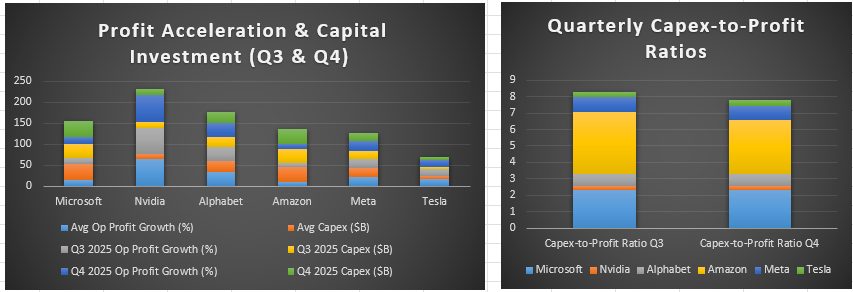
The Artificial Intelligence sector has led to the boom in cutting edge technology. The new highs of S&P 500 are fuelled by multiple AI related stocks Q3 and Q4 of 2025. AI startups and enterprises attracted massive venture capital with over 62% of investments in Q3 allocated to companies like OpenAI, Anthropic, and others. The venture capital market of USA saw around $97 billion funding in Q3 2025, with AI capturing nearly half of this. The huge investment by Magnificent Six on Research and Development for AI related products spiked 240% year on year. This shows a race to build and acquire capabilities rather than just organic build outs within organizations. To cite an example Microsoft recorded $34.9 billion capital expenditure in Q3 2025, rising 74% YoY, primarily on AI initiatives and data centres. Similarly, Alphabet raised its 2025 revenue forecast, driven by AI-related growth.
Impact on Quarterly Earnings and Profitability
AI investments are having a clear influence on top-line revenue growth and market valuations of leading tech giants. Nvidia, a leading AI chipmaker, reported record Q3 sales of $57 billion, a 62% increase YoY, driven by surging demand for AI data centre chips. It raised revenue forecasts to $65 billion for the ongoing quarter, outperforming analyst expectations. Microsoft posted an 18% rise in revenue to $77.7 billion and a 12% profit increase to $27.7 billion, driven by AI-enhanced cloud computing services and commercial subscriptions integrating AI functionalities like Copilot. Alphabet saw a 33% profit increase to about $35 billion in Q3 2025, largely due to its AI investments and service expansions. But broader enterprise impact remains mixed. McKinsey’s 2025 global AI survey reveals that while almost 40% of companies attribute some EBIT uplift to AI, most report less than 5% impact on EBIT. Only about 6% are “AI high performers”. They are achieving more than 5% of EBIT contribution, often through ambitious AI transformation and scaled innovation.
AI’s role in boosting innovation
Many companies underscore AI’s role in boosting innovation, customer satisfaction, competitive differentiation, and operational productivity. Theses are key drivers for future profitability not fully visible yet in short-term earnings. Despite strong earnings and AI-driven growth stories, investor sentiment has shown caution with some profit-taking observed amid overall market volatility, reflecting high valuation multiples and tempered near-term expectations.
Surge in Stock price
The S&P 500 has reached record highs in 2025, but research shows that roughly 70% to 80% of total index gains are due to spectacular performances by a small club of tech giants. To cite an example Nvidia ’s share price soared more than 20% from July to October, following another quarter of record data centre GPU sales. This is a direct, visible value transfer from AI investment to share price appreciation. Microsoft and Alphabet (Google) both experienced double-digit percentage stock rallies as they reported strong AI-related growth in cloud, AI services, and productivity software. Meta Platforms saw stock volatility. There was a surge on robust AI driven ad revenue, but there was also wavering post earnings due to concerns about the size and immediate payoff of mounting AI capital expenditures, even though the company’s profits rose year-on-year.
Direct link between AI investment and share price
Investor enthusiasm is rooted in the clear translation of AI capex into new product launches. There are a high digital demand and quantifiable revenue and margin growth at the biggest tech names. Nvidia stands out as the category defining AI winner keeping its share price at record highs. Microsoft and Alphabet were also rewarded as their quarterly financial disclosures explicitly tied AI rollouts to revenue increases and guidance upgrades. For these stocks, AI is not merely “potential”. It is now a material present day value driver, reflected directly in share prices and market cap.
Bottomline
The real and immediate value gain from Artificial Intelligence has been sharply concentrated in a handful of mega-cap technology leaders, powering visible increases in both share price and overall market indexes. Companies have invested unprecedented sums into AI infrastructure and product development. They are realizing outsized returns, as evidenced by exceptional profit growth, repeated earnings beats, and a dominant influence over S&P 500 performance. This cycle marks the first time that AI investment outcomes are directly observable within quarterly results, with tangible revenue and margin contributions. The market has recognized and rewarded these firms, with their share prices surging far beyond sector averages, collectively adding trillions in market capitalization in just six months. However, for major financials, healthcare, and industrials, AI remains an operational lever rather than an earnings rocket: efficiencies are being realized, but headline profitability and share price gains are modest and lag the hype.
Sources of Data: , .
This article is for informational purposes only and does not constitute investment advice.