
1. The Evolution of Capital Flows
Investment leadership over the past decade has followed a recognisable sequence. Geopolitical conflict reshaped defense budgets and rerouted global supply chains. Artificial intelligence attracted unprecedented private and public capital, minting new winners in GPU manufacturing, hyperscale data-centre construction, and a generation of high-profile IPO candidates. Each of these themes delivered returns to investors who identified them early. Each has also attracted capital in proportion to its visibility, which is precisely why the marginal opportunity may now lie elsewhere.
The market is beginning to ask the right question: what comes after the first-wave winners? History offers a reliable guide. The most durable capital allocation opportunities have rarely been the ones generating the most headlines. They have been the ones quietly enabling the winning technology to function at scale.
2. Analyst View: From Innovation to Infrastructure
Every major innovation cycle follows the same two-act structure. The first act rewards the pioneers, the companies building the technology, defining the category, and capturing early-mover valuation premiums. The second act rewards the enablers, the companies building the infrastructure without which the technology cannot scale.
Railroads created demand for steel. The internet created demand for fibre networks and data centres. Smartphones reshaped the global semiconductor ecosystem. AI is beginning a similar transition.
The first act of the AI cycle has produced extraordinary returns in GPU manufacturers, foundation model companies, and the private markets surrounding them. The second act may be defined not by who builds the most capable model, but by who solves the physical constraints required to run it.
The next decade may belong not to the companies creating intelligence, but to those enabling it at scale.
3. The Next Major Investment Themes
A. Energy Infrastructure: The Grid as the Constraint of the Decade
AI data centres consumed 485 TWh of electricity in 2025, up 17% year-on-year, with AI-specific facilities growing 50% in a single year (IEA). The IEA projects that figure will roughly double by 2030, representing close to 3% of total global electricity demand. The constraint is not generation capacity. It is transmission infrastructure that was designed for a pre-digital world.
BloombergNEF forecasts $5.8 trillion in cumulative global grid investment through 2035. Transformer lead times have extended to 18–24 months in some markets. Permitting a new transmission line in Europe takes 12 to 17 years on average. Meanwhile, the pipeline of conditional offtake agreements between data-centre operators and small modular reactor projects has grown from 25 GW to 45 GW since end-2024 (IEA, April 2026), signalling that the nuclear revival is not a speculative narrative, it is a procurement decision.
Key risk to monitor: Permitting timelines, interest rate sensitivity of capital-intensive infrastructure, and the concentration of grid investment within a narrow supplier base.
B. Industrial Automation: The Quiet Productivity Revolution
Labour markets across developed economies remain structurally tight. Reshoring of semiconductor, pharmaceutical, and advanced manufacturing capacity is accelerating under tariff regimes and national security imperatives. The result is rising demand for robotics, machine vision, smart factory integration, and collaborative automation, not as a cyclical upgrade, but as a structural response to input cost pressures that are unlikely to reverse.
The International Federation of Robotics reported 4.66 million operational industrial robots globally in 2024, up 9% year-on-year. The global industrial robotics market stands at an estimated $54 billion in 2026, projected to reach $94 billion by 2031. Unlike consumer AI applications, industrial automation delivers near-term, measurable productivity improvements to customers with predictable capex cycles, a profile that tends to support earnings visibility.
Key risk to monitor: Execution risk in large system integrations, cyclicality of manufacturing capex in a downturn, and China’s dominant share of global installations (54%) creating geopolitical exposure.
C. Cybersecurity: The Bill That Grows With Complexity
Cybersecurity has transitioned from an IT line item to a national security and macroeconomic imperative. Gartner estimates worldwide end-user security spending at $244 billion in 2026, on a path toward $663 billion by 2033. Cybercrime is projected to cost the global economy $10.8 trillion in 2026 alone (Cybersecurity Ventures). Regulatory mandates, the EU’s NIS2 Directive, DORA in financial services, US Executive Order on Zero Trust architecture, are creating non-discretionary procurement floors across tens of thousands of enterprises.
AI both strengthens and complicates this picture. Automated threat detection is meaningfully faster than human analysis. But the same AI tools lower the cost of phishing, ransomware, and social engineering at scale, sustaining a structural arms race in security spending that is largely decoupled from the broader economic cycle.
Key risk to monitor: Elevated multiples leave limited room for execution disappointment. Platform consolidation among large vendors may compress growth for smaller specialists.
D. Physical AI Infrastructure: The Overlooked Prerequisite
Investors understand AI’s electricity demand. Fewer have fully priced what happens once power arrives at the data-centre door. A hyperscale facility can consume millions of litres of water daily for cooling. The industry-wide shift from air-cooled to liquid-cooled rack architectures, driven by rising GPU thermal density, is creating demand for specialized engineering, industrial HVAC, and water infrastructure that did not meaningfully exist at scale five years ago. These physical requirements are structural prerequisites for AI capacity, not optional enhancements.
Key risk to monitor: Water scarcity constraints in key data-centre geographies, planning and permitting delays, and dependency on a limited number of large hyperscaler customers.
4. Valuation Reality Check
The right theme does not automatically create the right investment. Cisco was a genuine winner of the internet revolution, and remained one of the most important companies in networking for the two decades that followed. Investors who bought shares at peak enthusiasm in early 2000 waited more than twenty years to recover their capital.
Energy infrastructure companies have re-rated sharply as the power demand thesis gained institutional acceptance. Cybersecurity multiples remain elevated relative to historical norms. Industrial automation names tied to reshoring narratives saw meaningful appreciation through 2024 and 2025. Investors entering these themes in 2026 need to be selective about entry points, realistic about time horizons, and disciplined about valuation, even when the structural thesis is sound.
Infrastructure investment cycles do not resolve in quarters. They resolve in decades. The distinction between a great industry and a great investment is the price paid to own it.
5. Looking Ahead
The probability of sustained infrastructure spending over the next decade appears higher today than at any point since the early stages of cloud computing. Governments across the US, Europe, and Asia are directing significant public capital toward grid modernisation, industrial capacity, and digital security, and private capital is following. The IEA’s projection that data-centre electricity consumption will roughly double by 2030 is perhaps the clearest summary of the structural opportunity. Every megawatt of that demand requires generation, transmission, and distribution. Every factory automating its assembly line requires integration, maintenance, and ongoing software support. Every organisation expanding its digital footprint requires cybersecurity protection that compounds with the complexity of the environment it defends.
The highest-probability opportunities over a 3–10 year horizon are likely to be found not in predicting which AI model wins, but in identifying the physical and digital infrastructure without which no model can operate at commercial scale.
6. Closing Thought
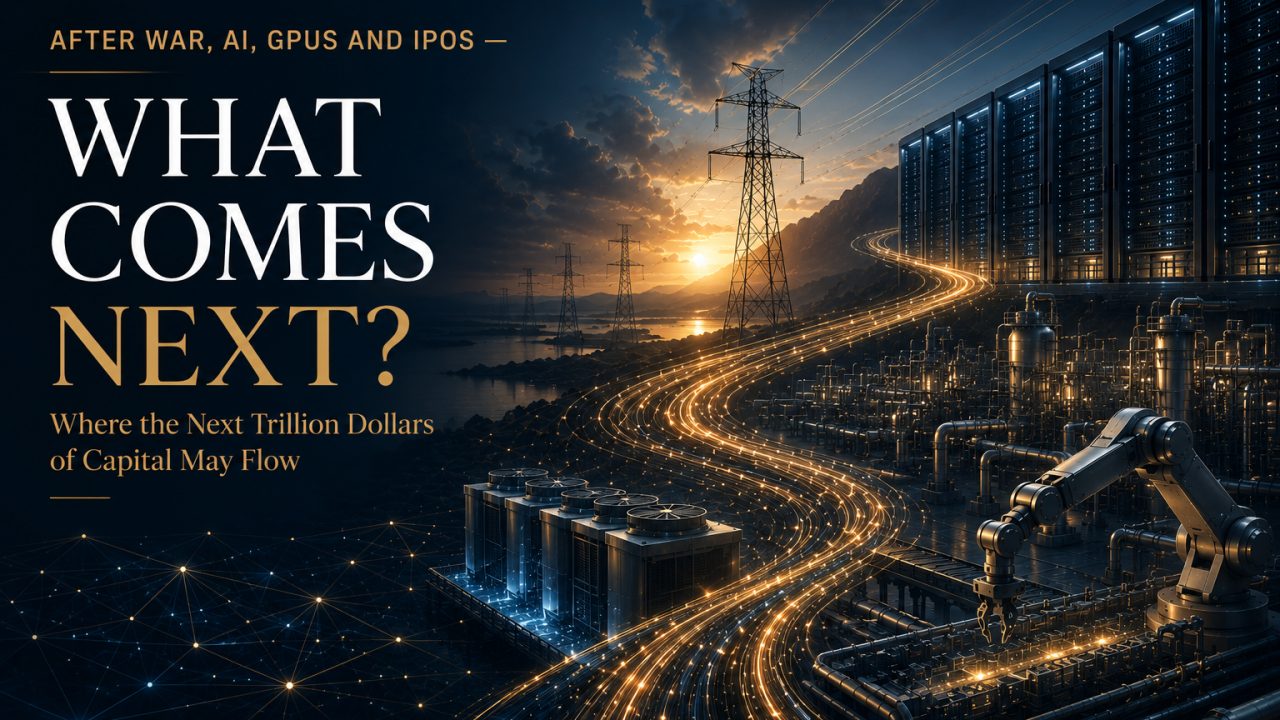
After geopolitical conflict reshaped defense budgets, after AI rewrote the software stack, after GPUs became the most strategically important commodity in the world, and after private-market valuations reached levels that demanded exceptional execution, the market is asking where the next trillion dollars of capital will flow.
The answer may not be found in the next foundation model, the next GPU generation, or the next high-profile IPO. It may be found in the grid carrying the electricity, the robot on the factory floor, the cooling system managing the heat, and the software detecting the breach before the attacker has time to act.
Infrastructure rarely captures the headlines, but it often captures the economics. The next decade may belong not to the companies creating intelligence, but to those enabling it at scale.
References
Energy Infrastructure
- International Energy Agency (IEA). Electricity 2025: Analysis and Forecast to 2027. IEA, Paris, 2025.
- International Energy Agency (IEA). Electricity 2026: Analysis and Forecast to 2030. IEA, Paris, 2026.
- International Energy Agency (IEA). Key Questions on Energy and AI. IEA, Paris, April 2026.
- IEA. Tracking Clean Energy Progress: Grid and Storage. April 2026 Update.
- BloombergNEF. New Energy Outlook 2025: Global Grid Investment Forecast 2026–2035. BloombergNEF, 2025.
Industrial Automation
- International Federation of Robotics (IFR). World Robotics 2025: Industrial Robots. IFR, Frankfurt, September 2025.
- ABI Research. The Global Robotics Market Outlook 2025–2030. ABI Research, 2025.
- McKinsey Global Institute. The Future of Work After COVID-19: Automation and Workforce Transitions. McKinsey, 2025.
Cybersecurity
- Gartner. Forecast: Information Security, Worldwide, 2023–2029. 4Q25 Update (G00843183). Gartner Research, December 2025.
- Cybersecurity Ventures. Cybercrime Report 2025: Annual Global Cost Projections. 2025.
- IBM Security. Cost of a Data Breach Report 2025. IBM, 2025.
- European Union Agency for Cybersecurity (ENISA). ENISA NIS360 2026: Cybersecurity Maturity of NIS2 Critical Sectors. ENISA, 2026.
- Microsoft Corporation. FY2025 Q4 Earnings Press Release. Microsoft Investor Relations, July 30, 2025.
This article is for informational purposes only and does not constitute investment advice.